
By Brock
With December being Christmas time, my favorite time of year, I chose Catholicism as the religion I would follow for the month. After a month immersed in the vast and multifaceted world of Hinduism, I was eager to experience a faith with a more defined structure, and more universally established traditions. I also love Christmas. The music, the stories, the movies, it is my favorite time of year. Originally, I planned on practicing Protestantism for this month, but I realized it is deeply ingrained in the cultural fabric of the Southern United States. I see Protestantism in everything. I yearned for something I would have to search for, something that demanded a conscious effort, a journey of discovery beyond the familiar.
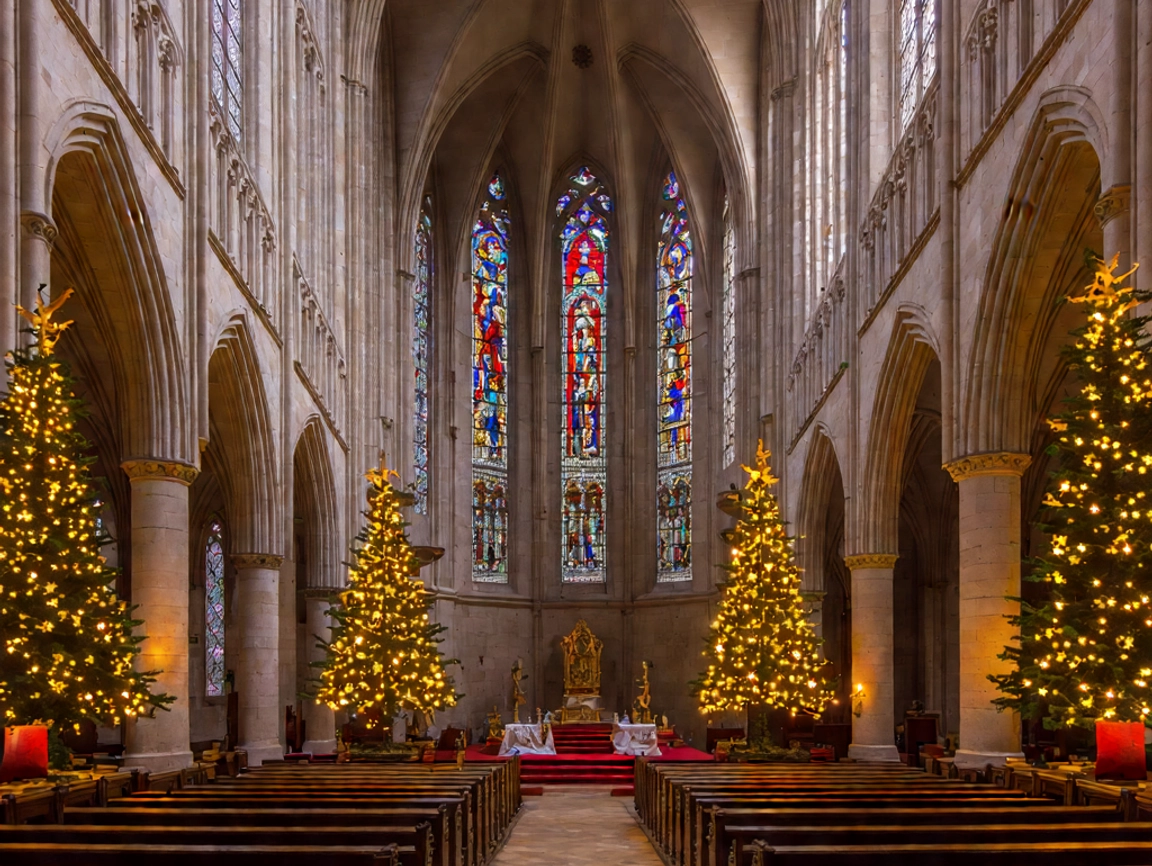
One of my favorite aspects of Catholicism are the cathedrals. These have always exerted a powerful fascination over me. Having visited over a hundred across the globe, I never miss an opportunity to enter these awe-inspiring structures. Their sheer scale and architectural grandeur bear witness to the desire for mankind to connect with the divine. Stepping inside a cathedral feels like stepping back in time, connecting me to centuries of human history and the countless souls who have walked these hallowed halls before me. Each longing, wondering, and praying for something bigger than themselves. I am drawn to the sense of shared human experience, the palpable connection to the past that permeates these sacred spaces.
Furthermore, cathedrals are profoundly spiritual places. The hushed reverence, the soft light filtering through stained glass windows, the intricate details of the artwork – all these elements create an atmosphere that transcends the mundane. It’s a space where the focus shifts inward, while the mind looks upward. Where one can contemplate the spiritual, connect with a sense of something larger than oneself, and perhaps even experience a fleeting moment of transcendence.
This inherent focus on the divine, on the connection between humanity and something greater, is a core element that resonates deeply with me. Whether it’s the soaring arches reaching towards heaven, the intricate depictions of biblical stories, or the simple act of sitting quietly in contemplation, cathedrals offer a unique opportunity for reflection and spiritual exploration.”
Catholicism stands as a cornerstone of Christianity, offering a rich history of beliefs and practices that have shaped Western civilization for centuries. As the oldest and largest Christian denomination, it provides a crucial foundation for understanding the broader spectrum of Christian thought and practice.
Growing up in a Mormon household, I developed a deep reverence and personal relationship with Jesus. Mormonism, like Catholicism, places a strong emphasis on Christ’s teachings and his role as the Son of God. I spent hundreds of hours as a child and into my early twenties praying and talking to Jesus. In a way, this month felt like I was trying to rebuild a relationship with an old friend.
Catholicism places a strong emphasis on ritual. And, I believe rituals are an integral part of our spirituality journey. Rituals, across all cultures and belief systems, possess a unique power.They create sacred space, allowing us to step outside the mundane and connect with something deeper within ourselves and with the world around us.Whether it’s the daily act of meditation, the shared meal with loved ones, or the elaborate ceremonies of a religious tradition, rituals provide a framework for intention, a way to mark significant moments in our lives and to cultivate a sense of meaning and purpose.
Furthermore, Catholicism places a strong emphasis on the Virgin Mary and the saints, offering a diverse array of figures for devotion and intercession.The concept of the Communion of Saints, the belief that the faithful in heaven intercede on behalf of those on earth, is a unique and interesting facet of Catholic theology.
Catholicism and my twenties
My first significant encounter with Catholicism occurred unexpectedly about twenty years ago. It was a tumultuous time in my life. I had recently left the Mormon church, not because I had lost faith, but because I had fallen in love. My world had shifted dramatically. As discussed earlier, I lost my childhood faith in a kiss. I met Travis, a charismatic and unconventional soul who ignited a fire within me. Our connection was immediate and intense. I remember the day he kissed me after going to a movie together, a simple gesture that filled me with a joy I had never experienced before. It was exhilarating, a liberating departure from the expectations and constraints I had grown up with.
Life with Travis was a whirlwind of new experiences and emotions. We explored, discovered ourselves, and spent countless hours engaged in deep conversations that stretched late into the night. I was completely immersed in this new chapter, my mind and heart overflowing with love and excitement.
However, beneath the surface of our idyllic existence, a dark shadow loomed. Unbeknownst to me, Travis was carrying a heavy secret. The day we shared that first kiss, was the day Travis had learned he was HIV positive. He had called me after his diagnosis to escape the havoc playing out in his head. He wanted someone he could just be with and not worry about his future. In me he got much more than he thought he would.
In the early days of the AIDS epidemic, this was a devastating diagnosis, it was considered a death sentence. The stigma surrounding HIV/AIDS was pervasive, fueled by fear and misinformation. I vividly remember the chilling pronouncements from some members of my own family when I was younger, echoing the rhetoric of the time, suggesting that AIDS was a divine punishment for the gay community. As a child, there were nights when I would go to bed crying, terrified. I knew I was gay, even at a young age. I was sure God was going to kill me by giving me AIDS.
When Travis finally told me, six months into our relationship, I was completely unanchored. He had waited because he was afraid to lose what he had. He had already lost so much. The news shattered my world, leaving me reeling with fear and uncertainty. I cried for days, consumed by grief and self-doubt. I slept in my car. I sought solace from those I thought were wise, but their words offered little comfort. The prevailing narrative, steeped in prejudice and ignorance, left me feeling isolated and alone. I even found myself questioning my own worth, wondering if I was somehow being punished for my own happiness.
I decided to stick with Travis. We would simply be celibate. Easy.
During this agonizing period, Travis was offered a job as an organist for a local Catholic congregation. We both loved to play the piano and this was something he was very excited about. I decided to attend the service and hear him play. Attending Mass provided a surprising sense of peace. The hushed reverence of the congregation, the intricate choreography of the service, the resonant chants of the choir – it all created a sense of awe and wonder. The beauty of the stained-glass windows, bathed in the soft light filtering through them, offered a momentary escape from the darkness that had descended upon my world. I went back many times.
Also, during this time, we met a retiring priest at the church. He was a kind and gentle soul, a man of faith who had dedicated his life to serving his community. I was intrigued to learn that he was gay, yet had chosen a life of celibacy. His story challenged my assumptions, reminding me that faith and sexuality were not mutually exclusive. I couldn’t fully comprehend his path, but I felt a deep sense of respect and admiration for his unwavering commitment to his faith and his community.
While Travis and my relationship ended after two years, this period of my life, marked by both joy and heartbreak, proved to be a profound turning point. The experience of attending Mass, the unexpected encounters with individuals like the retiring priest, and the gradual healing process that followed all contributed to my spiritual growth. Catholicism, though not the path I ultimately chose, served as a small but significant waystop on my journey of self-discovery and spiritual exploration.
The Gospels
As part of my journey to understand Catholicism, I embarked on a deeper dive into the heart of Christianity: the Gospels. Having spent the previous months exploring Eastern philosophies like Buddhism, Jainism, and Hinduism, I was eager to return to my Christian roots, albeit from a fresh perspective.
Instead of reading the Gospels in the traditional order, I decided to approach them chronologically, focusing on the key events in Jesus’ life as depicted by each of the four evangelists: Mark, Matthew, Luke, and John. This approach, I believed, would allow me to appreciate the nuances and unique perspectives offered by each account.
I began by examining the birth narratives, a fascinating exercise in itself. Matthew and Luke, the only Gospels to include these accounts, offer strikingly different portrayals of Jesus’ birth.Matthew emphasizes Jesus’ Jewish heritage, tracing his ancestry back to King David, fulfilling Old Testament prophecies.He famously includes the story of the Wise Men and their gifts of gold, frankincense, and myrrh.Luke, on the other hand, focuses on the human element, portraying Jesus as a humble servant of God, born into poverty and embraced by shepherds.
This initial comparison highlighted the diverse perspectives and potential embellishments that can occur in the transmission of oral and written traditions. It became clear that each Gospel, while sharing common themes, also reflected the unique concerns and intended audiences of its author.
Continuing this chronological approach, I followed Jesus’ ministry, comparing, and contrasting the different accounts of his teachings, miracles, and interactions with his disciples.
- Mark, widely considered the earliest Gospel, presents a fast-paced and action-oriented narrative, emphasizing Jesus’ authority and power. It portrays Jesus as a dynamic and demanding teacher, often highlighting his human struggles and emotions. Mark’s Gospel is known for its brevity and its focus on the suffering and crucifixion of Jesus. I also love that throughout Mark’s gospel everyone must keep the “messianic secret” and not tell who Jesus is.
- Matthew, written for a Jewish audience, emphasizes Jesus’ fulfillment of Old Testament prophecies. It presents Jesus as the long-awaited Messiah, the King of the Jews, and highlights his teachings on the Kingdom of Heaven. Matthew includes many unique parables and emphasizes Jesus’ authority as a teacher and rabbi.
- Luke, provides a more detailed and compassionate account of Jesus’ ministry, emphasizing his concern for the poor, women, the marginalized, and the outcast. He includes numerous parables and stories that illustrate Jesus’ message of love, compassion, and social justice. Luke’s Gospel also includes the stories of the birth of John the Baptist and the childhood of Jesus, offering a more comprehensive narrative of Jesus’ life.
- John, written later than the other Gospels, offers a more theological and philosophical perspective. It emphasizes Jesus’ divinity, his role as the Word of God, and the importance of faith and belief. It includes very few of the same stories as the other gospel and that is why it is not considered synoptic. John’s Gospel is characterized by profound theological discourses and mystical experiences, offering a deeper understanding of Jesus’ relationship with God and his followers.
Using a comparative approach revealed wonderful insights into the diverse perspectives and theological emphases of each Gospel. I was struck by the similarities, but even more so by the differences in their accounts, the unique insights each offered into the life and teachings of Jesus.
Furthermore, this study brought to light the potential for embellishment and the gradual evolution of these narratives over time. For example, the well-known story of Jesus intervening to prevent the stoning of an adulterous woman does not appear in the earliest manuscripts of any of the Gospels. This suggests that this powerful story, which highlights Jesus’ message of compassion and forgiveness, may have been added later as a reflection of the evolving theological and social concerns of the early Christian communities.
Journeying through the Gospels challenged my assumptions, deepened my understanding of Christian theology, and provided a renewed appreciation for the enduring power of the Christian message. It also highlighted the importance of critical analysis and the recognition that these ancient texts, while deeply meaningful, are also influenced by their historical and cultural contexts.
Family Day
This year, however, we decided to stay home, save money, and spend time with family who were visiting for the holidays. While I cherished the opportunity to connect with loved ones, I couldn’t shake off a tinge of disappointment. Our “Family Day,” a date that held such profound personal meaning, felt somewhat diluted amidst the flurry of holiday activities. It was difficult to carve out space for introspection and truly celebrate the unique significance of this day, knowing that our guests, while cherished, were not intimately involved in the history and emotions of our little holiday.
December is important to us for more reasons than Christmas. December 15th holds a special significance for our family. It’s our “Family Day,” a date that commemorates both the day I met my husband. Since we were not legally able to marry for the first 7 years we were together, this was our anniversary. It is also the miraculous day five years later when our daughter, Olivia, entered our lives. We typically mark this occasion with a grand celebration, often embarking on an adventurous trip to a far-off destination like Paris or London.
We enjoyed a lovely dinner out, raising a glass to the milestone. Later, in the quiet of our house, I reflected on the profound changes that had taken place in our lives since our first meeting, the joys and challenges we had faced together, and the beautiful family we had created. Most importantly, I recognized that “Family Day” was no longer about the three of us. It was now about the ever-expanding circle of love and connection that surrounded us. Our family was getting bigger, and that was always the ultimate goal.
Getting Olivia
The journey to parenthood had been a long and winding road. I had always yearned to have a kids. John took just a little convincing. We had explored multiple paths towards adoption. And we had faced countless disappointments along the way. Numerous promising placements had fallen through, often due to the simple fact that we were a same-sex couple. We had encountered prejudice and faced rejection; our hopes repeatedly dashed. Our adoption agency, with a touch of blunt honesty, had even cautioned us that the chances of us being selected to adopt a healthy infant were “nearly impossible.”
Despite these setbacks, we clung to a small piece of hope. We never expected a baby, and we were determined to be happy with any child. Each new opportunity met with a mixture of excitement and trepidation.
When our agency presented us with yet another potential placement, we accepted, though our expectations were tempered by past disappointments. We were one of eleven families vying for the opportunity to adopt this precious baby, facing stiff competition from other hopeful families. And, we had a new Case Manager at our adoption agency. She had never met us. How could she possible advocate for us?
The day of the adoption committee meeting arrived. I spent the day doing housework. I fully expected to receive a call later that day, informing us that we had been unsuccessful, again.
Then, the phone rang about 30 min after the meeting started. It was our adoption coordinator. Her voice, usually calm and measured, was filled with an unexpected excitement. “It’s a miracle,” she exclaimed. “It was unanimous the first round! This is unheard of! Every single member of the committee voted for you.” The news hit me like a tidal wave. Tears streamed down my face as I struggled to comprehend the magnitude of this unexpected news. I immediately called John, my voice trembling with disbelief and joy.
The whirlwind that followed was a blur of emotions. We were told to expect a few weeks before meeting our child, allowing us time to prepare for the arrival of our little one. Then, came the another phone call: the agency decided to expedite the process, informing us that we would be welcoming our baby home within just two days.
The next few days were a whirlwind of activity and emotions. We prepared our home, and transformed a spare room into a nursery. We received an outpouring of support from friends and family, showered with gifts and well wishes. The community rallied around us, offering assistance and encouragement. We even received enough donations to fully furnish the nursery and cover all the expenses associated with welcoming our baby into our lives.
She was the best Christmas present, ever.
Burn
Like most months during this journey, there always seems to be one test. One challenge to see how I am applying what I have learned. One such incident occurred while I was attempting a seemingly simple household chore: cleaning the stovetop. In my enthusiasm to remove a stubborn stain, I inadvertently sprayed cleaning solution directly onto the igniter, deep within the gas burner assembly. The immediate result was a persistent clicking sound, a constant, irritating noise.
I turned to my newfound expertise in home improvement: YouTube. In recent years, I had become quite adept at tackling minor household repairs with the help of online tutorials. I confidently switched off the stovetop, assuming I had also shut off the gas supply. However, I failed to notice the second gas valve, located behind the stove.
Determined to resolve the issue, I proceeded to dry the igniter as best I could, though access was limited. Frustrated, I resorted to a seemingly logical solution: I attempted to dry the igniter by forcefully blowing on it.
The next moment was a blur of heat and terror. With a sudden whoosh, a flame erupted from the burner, shooting upwards and engulfing my face. The searing heat singed my hair and scorched my eyelashes and eyelids. The smell of burning hair filled the air, leaving a lingering, acrid taste in my mouth. I fell backwards, grabbing my face and thinking I had been badly burned. But, it was just a burst of flames, nothing long enough to do significant damage.
In the aftermath of this terrifying experience, I was struck by the sheer force of the unexpected. I had escaped with minor burns, and it could have been much worse. I texted John to not be alarmed by the smell, but of course, that was the first thing everyone noticed when they came into the house. I lost hair on the front, parts of my eyebrows and eyelashes, and suffered some minor burns. But, it was nothing a little haircut couldn’t hide.
This was not the first time we had encountered such a close brush with disaster. Years earlier, we had attended a concert that was unexpectedly canceled. Upon returning home, we discovered that a candle left burning outside had heated the glass votive it was in until it burst and caught part of our porch on fire, threatening to engulf our house in flames. Had we returned home even a few minutes later, the consequences could have been devastating.
These experiences, while frightening, have instilled in me a profound sense of gratitude for what we have, and how easy it can be lost. They have served as reminders of the fragility of life and the importance of cherishing each moment, act carefully, and be grateful.
Christmas
This year, the Christmas season unfolded with a quiet reverence, a stark contrast to the frenetic energy that had typically accompanied past holidays. The aftermath of the hurricane, the anxieties surrounding job searching, and the challenges we had faced in recent months had shifted my perspective. My year-long exploration of diverse faiths – Buddhism, Jainism, and Hinduism – had subtly altered my relationship with material possessions. I was learning to appreciate the simple pleasures in life, to find joy in experiences rather than things. The emphasis on mindfulness and non-attachment in these philosophies was changing me. The desire to acquire, to possess, to constantly strive for more, began to feel less compelling.
As a result, the focus on gifts, felt somewhat muted this year. The thought of receiving things, especially things I didn’t need, felt almost frivolous. Even Olivia, perceptive beyond her years, commented on the shift in our holiday preparations. “It feels different,” she observed, noticing the absence of the usual frenzy of gift-giving.
And indeed, it was different. This Christmas, the emphasis shifted from accumulating material possessions to cultivating gratitude and giving to those in need. I found myself cherishing the quiet moments, the warmth of the crackling fire, the laughter and heartfelt conversations.
The realization that I could find happiness with less, that I could live a bigger life with a smaller footprint, was a radical gift. I received things I did not know I needed, contentment, inner peace, and meaningful relationships. Things that cannot be placed under a tree, yet they made this the most important Christmas yet.
End of year Reflection
Instead of the usual New Year’s resolutions, I chose a word to guide me through the year. For 2024, the word I chose was “Heal.” I needed to prioritize healing on all levels: emotionally, spiritually, and within my relationships. This word, “Heal,” became my mantra, a constant reminder of my intention to mend the broken pieces, and to emerge from this period of transition stronger and more whole.
Buddhism, with its focus on mindfulness and compassion, helped me to embrace the present moment and cultivate a sense of equanimity. Shinto, with its reverence for nature, helped me reconnect with the natural world, offering solace and grounding amidst the chaos. Jainism, with its emphasis on non-violence, taught me to cultivate inner peace and navigate the emotional turmoil with greater compassion. Judaism, with its rich history and tradition, reminded me of the importance of community and the power of ritual in fostering connection and meaning. Hinduism, with its vastness and inclusivity, offered a profound understanding of the interconnectedness of all things, embracing the cyclical nature of life and death. And finally, Catholicism, with its emphasis on ritual, love, and forgiveness, provided a sense of comfort and solace during times of doubt and uncertainty.
Each of these faith traditions, in its own unique way, offered a pathway to healing. They provided me with a framework for understanding my own emotions, for navigating the complexities of life, and for cultivating inner peace. They helped me to recognize the interconnectedness of all things, to embrace the beauty of imperfection, and to find meaning and purpose even while suffering.
The hurricane, while a devastating event, ultimately served as a catalyst for personal growth. It forced me to confront my own limitations, to rely on the support of community, and to rediscover the resilience of the human spirit. The job loss, initially a source of immense stress, ultimately led to a period of unexpected growth and self-discovery. It forced John to re-evaluate his priorities, to rediscover his passions, and to find a new path, one that aligned more closely with his values and aspirations.
Perhaps the most profound lesson I learned during this period was the diminishing importance of material possessions. Stuff is just stuff, and I can continue on happily with or without it. As I reflect on the half way point of my study in religion, it has helped tremendously in my healing, not just from external wounds, but from the deeper, more internal scars. It has been a path towards self-discovery, a process of shedding old skins and embracing new beginnings. It has been a reminder that even in the darkest of times, there is always hope, always the possibility for renewal and growth.
I have learned to embrace the ebb and flow of life, to find joy in the present moment, and to trust in the unfolding of my journey. I have learned to cultivate inner peace, to nurture meaningful relationships, and to find beauty in the imperfections of life. I have learned to listen to my intuition, to trust my inner compass, and to follow my heart, even when the path is uncertain.
As 2024 draws to a close, I am filled with a sense of peace and anticipation. I am ready to embrace the challenges that lie ahead, knowing that I have the strength and resilience to navigate whatever comes my way. I am ready to continue my next steps towards self-discovery, to explore new horizons, and to live a life of purpose and meaning.
This year, I have healed. I have grown. I am ready for the next steps.
Leave a Reply