
Some of the best trips are the ones you never planned.
That is the magic of flying standby. You don’t always know where you are going until the very last moment, and sometimes the places you stumble into become the ones that stay with you the longest.
That is exactly what happened with Colombia.
We had been looking for somewhere to go, refreshing flights and watching options disappear as routes filled up. Then suddenly, seats opened to Barranquilla.
After all, this is the hometown of Shakira and Sofía Vergara, and we laughed to ourselves, How could it not be a party city if both of them are from here?
So we said yes. We said yes to Rio the year before, so we figured we needed to give more of South America and chance.
And from the moment we landed, Colombia began to surprise us.
First Impressions of Barranquilla
The drive from the airport to our Airbnb in Barranquilla was one of the most vivid introductions to a city I have ever had. It felt like stepping directly into the bloodstream of a place already fully alive. The streets pulsed with frenetic movement—people walking everywhere, taxis darting in and out of traffic, buses pressing forward, motorcycles weaving through impossibly small spaces, and everywhere, donkey carts piled high with bananas and other goods moving steadily through it all. The taxis and buses were constantly shifting around them, flowing in and out in this wild, almost choreographed dance of motion.
At one point, as our taxi driver threaded his way between a bus, a donkey cart, and what felt like an impossible gap in traffic, I remember leaning back in the seat and saying, “Oh my God, this is where I die.”
The bus seemed to be flying straight toward us.
And yet somehow, everyone seemed to know exactly what they were doing.
There was this extraordinary rhythm to it all—a kind of unspoken choreography where thousands of people were weaving, dodging, merging, and somehow moving together in perfect chaos. For all the motion and near misses that made my heart race, I did not see a single accident. And, I did not see a single ego behind the steering wheel.
Once we got settled, Barranquilla began to open itself to us. We found lovely shops, had some truly amazing food, and visited the Museo del Carnaval, which was one of our favorite discoveries. Since we love Mardi Gras, it felt like finding a joyful cousin to that same spirit of color, celebration, and spectacle.


Cartagena
Still, our eyes were already turning toward Cartagena. We had heard people back home talk about. Saying it was on their bucket list.
Only a couple of hours away, it was easy and inexpensive to get there, so we arranged a ride and headed out.
That drive was its own kind of education.
Parts of it were stunning—long stretches of beautiful coastline, views of beaches and water that made us want to stop every few miles. But it also gave us a window into parts of Colombia that many travelers never see. We passed through areas marked by visible poverty, neighborhoods that felt worlds away from the polished beauty of downtown Cartagena.
And then we arrived.
Cartagena did not simply impress us.
It enchanted us.


The Airbnb
We first checked into an Airbnb that remains one of the most extraordinary places we have ever stayed. Because it was a last-minute booking, they gave us a huge discount. We ended up in what felt less like an apartment and more like a private mansion tucked into the city.
It was enormous.
Downstairs, as you walked on from the street, there was a small plunge pool—almost like a hot tub crossed with a tiny swimming pool—perfect after long days of walking in the heat.
Then the space opened upward with swirling stairs around the pool and up into this breathtaking central atrium. The middle of the home was open to the air, allowing light to pour in from above while still being protected from the rain. Around it were rooms on all sides: bedrooms tucked into opposite corners, a huge living space, an oversized dining room, a large kitchen family room with cathedral-like ceilings, and a giant chandelier that made the entire place feel almost cinematic.
The Balcony That Became the Heart of the Trip
And then there was the balcony.
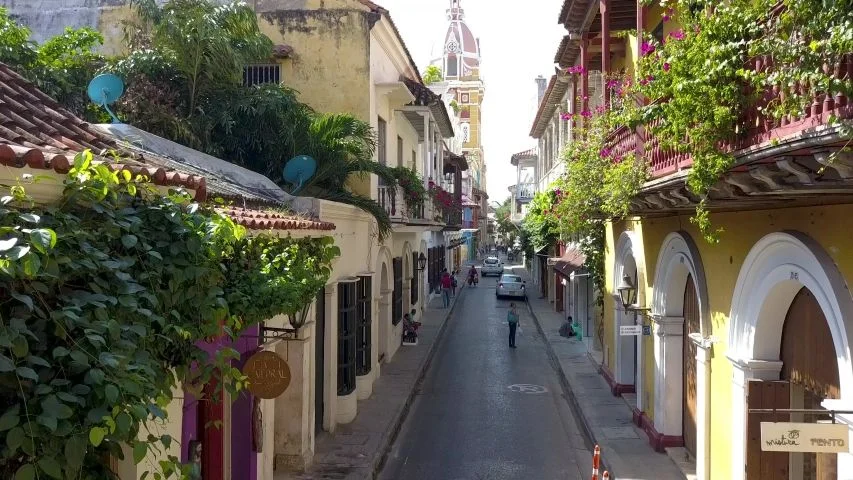
It stretched across three sections of doors and overlooked the street below, almost like a private front-row seat to the city’s unfolding life.
Every morning, I would sit there with coffee and simply watch Cartagena wake up.
If someone had offered me the beach or that balcony, I would have chosen the balcony every single time.
There was something almost sacred about those mornings.
Before the city became fully itself—before the music returned, before the streets filled with tourists, before the rooftop bars reopened—there was this slow, gentle rising of life. First came the sound of footsteps on the stone streets below. Then the voices. Then the vendors, already moving through the neighborhood with baskets of fruit balanced on their heads or carts filled with freshly cut pineapple, mango, and watermelon.
I could sit there for hours.
Some mornings I did.
The light would slowly spill across the old buildings, catching the flowers hanging from balconies across the street. The shutters would begin to open one by one. A café somewhere nearby would begin setting out chairs. Someone would laugh below. Someone else would call out to a friend across the street.
The whole city seemed to stretch awake.
What I loved most was that from the balcony, Cartagena felt intimate. At street level it was energetic and often crowded, but from above, it became almost theatrical. It was like watching the city rehearse itself each morning before the curtain rose on the day.
And after the madness of the night before, that contrast made it even more magical.


Cartagena After Dark
The first two nights, being surrounded by music from four different clubs and rooftops, we barely slept. At one point it felt as though the walls themselves were pulsing with four different rhythms.
Our apartment happened to sit directly beside Alquímico, one of the most famous cocktail bars in the world.
And not just beside it.
Our bedroom was somehow positioned right between two of its floors.
That meant on Friday and Saturday nights we could hear dancing and music coming from two different levels of the bar, each playing different songs, plus a rooftop above us and another bar behind us.
We did not get much sleep those first two nights.
And honestly?
It was perfect.
The hosts had warned us, we had agreed to it, and there was something wildly magical about being dropped into the center of the city’s nightlife like that.
Yet somehow, waking up the next morning and stepping out onto that balcony made it all worth it.
The quiet after the music. The softness after the celebration.
The morning light after the rooftop bars had gone dark.
It was the perfect counterbalance to Cartagena’s nightlife.
In fact, I think that balcony is where I truly fell in love with the city. Not in the bars. Not in the museums. Not even walking through Getsemaní at night.
It was there, coffee in hand, looking down at the women carrying fruit baskets on their heads, the street vendors setting up for the day, and the city slowly coming back to life.
If the nights belonged to Cartagena’s joy, the mornings belonged to its soul.
The Road to Getsemaní
By midday, the city shifts.
The historic center is breathtaking during the day—flower-covered balconies, bright facades, horse-drawn carriages, little cafés tucked into ancient corners—but as the day moves on, the energy builds.
One of the most unforgettable parts of the city was the walk into Getsemaní — just outside the walled city.
I honestly do not know if I have ever seen so much concentrated energy in one stretch of street.
Party bus after party bus lined the roads, waiting to be filled. Music pulsed from every direction. People laughed, danced, and moved through the streets with contagious joy.
Getsemaní felt especially magical.
Yes, it was crowded. Very crowded.
But it was one of those rare places where the crowd itself becomes part of the charm. Every narrow street seemed draped with umbrellas, flags, or lights overhead. Food was everywhere. Music was everywhere. Laughter was everywhere. And everywhere you turned, there were fruit carts.


Street Food, Fruit Carts, and Hidden Museums
This became one of my favorite things about Cartagena.
Street vendors lined the roads with perfectly cut fruit in cups, whole pineapples, mango, watermelon, papaya— snacks available almost anywhere for about a dollar.
We spent evenings wandering in and out of shops and rooftop spaces, and everywhere we went, people were incredibly kind. Even when there was a language barrier, people were warm, welcoming, and patient. Google Translate helped, but honestly, kindness did most of the work.
One of our favorite rooftop spots was Mar y Zielo. The view of the church tower rising above the city felt almost cinematic, and the dessert there was one of the best I have ever had.
We also loved the museums.
Museo del Oro Zenú was fascinating, and the emerald museum—Museo de la Esmeralda—was one of the most unexpected highlights, especially the crystal skull with the jade top they called the Skull of Judgment.

Is Cartagena Safe?
One of the things that stayed with me most about Cartagena was how safe and welcomed I felt.
I know that for many people, Colombia may still carry old assumptions or outdated fears, but that was simply not our experience. At no point did I feel like we were in danger. Even with people everywhere—music pouring into the streets, crowds filling the plazas, party buses lined up, rooftop bars buzzing late into the night—I never once felt afraid.
I can’t speak to places outside of Cartagena, I know there are places not to go in Columbia, but I never felt any sense of danger while there.
It felt much like any vibrant European city or busy American city, but with far more dancing in its bones, far more rhythm in the streets, and far more life pulsing through every corner. It was more party-esque, more celebratory, and somehow more alive.
Of course, as with any place full of travelers and crowds, you stay aware of your surroundings. There may always be the possibility of a pickpocket here or there in any major destination, but we never experienced anything negative.
What we experienced instead was warmth. Kindness seemed to overflow from everyone we met.
As a gay man, that sense of welcome matters deeply to me, and I never once felt uncomfortable being myself. Quite the opposite—I felt completely at ease. The city felt open, joyful, and deeply human.
Why We’ll Go Back to Cartagena
This trip began as an accident, a last-minute standby decision born out of open seats and curiosity.
It became one of the most magical family trips we have ever taken.
I already know we will go back.
Some cities impress you.
Cartagena stays with you.


Leave a Reply