
Introduction
Religion is one of humanity’s oldest languages. Long before written scripture, people carved figures, painted caves, and told stories around firelight about life and death, chaos and mystery. Religion at its core has always been about more than worship. It has been about orientation. It is finding meaning, comfort, and wholeness in a world full of unpredictability and awe.
When we trace humanity’s religious story, a striking pattern emerges. It doesn’t map neatly onto a traditional arc of growth and adventurous return to triumph, like those stories outlined in the Hero’s Journey made famous by Joseph Campbell. His is the tale of the lone adventurer who sets out, conquers monsters, and returns triumphant. Instead, it follows the pattern of the Heroine’s Journey, articulated by psychologist Maureen Murdock.
The Heroine’s Journey describes not conquest but healing. It charts the path of separation and imbalance, the costs of leaning too far to one side of ourselves, and the long work of reconciliation. If Campbell’s hero slays the dragon, Murdock’s heroine learns to integrate it.
Murdock outlined nine stages:
- Separation from the feminine
- Identification with the masculine and gathering allies
- The road of trials
- The illusory boon of success
- Awakening to spiritual aridity / descent
- Yearning to reconnect with the feminine
- Healing the mother/daughter split
- Healing the wounded masculine
- Integration of masculine and feminine
Although Murdock was writing about the psychological development of women, the pattern resonates more broadly. Humanity’s collective religious history mirrors these steps. We began with a balance of forces, tilted toward masculine alignment, endured trials of philosophy and empire, reached the “success” of monotheism, and entered the desert of spiritual aridity. Now, we find ourselves yearning for reconnection, for healing, and ultimately for wholeness.
This story is not about goddess worship replacing god worship, or one religion triumphing over another. It is about the deeper task of integration. It is bringing back together what was split apart. Just as the Heroine’s Journey is about reconciling feminine and masculine energies, our religious history may also be understood as a shift from whole-brain living — balancing the intuitive, imaginal right hemisphere with the analytical, ordered left — toward left-brain dominance. Our task now is to recover the balance of both brain and spirit.
Step One: Separation from the Feminine
Archaeological finds like the Venus of Willendorf (c. 30,000 BCE) and dozens of similar figurines suggest reverence for fertility, abundance, and cycles of life. But alongside them we find the Löwenmensch (Lion-Man), a 35,000–40,000-year-old ivory carving from Germany that blends human and animal form. Cave paintings in Lascaux and Chauvet depict herds of animals, hybrid beings, and mysterious figures.
What emerges is not a single-gendered spirituality but a many-sided sacred imagination. Early humanity seemed to honor fertility and birth, the strength needed for hunting and protection, and the mystery of animal-spirits that blurred the line between human and other-than-human.
In modern brain terms, this was closer to a whole-brain spirituality: the imaginative and intuitive capacities of the right hemisphere working in harmony with the practical and analytical skills of the left.
Yet as agriculture and hierarchy emerged, this balance tilted. With fields to manage, surpluses to protect, and borders to defend, societies privileged order, control, and hierarchy. Earth-based rituals and fertility symbols were not erased, but increasingly overshadowed. Humanity’s spiritual journey began with a gradual separation from qualities associated with the feminine. Qualities like nurture, embodied wisdom, cyclical rhythms, and intimacy with the natural world.
Step Two: Identification with the Masculine
By the Bronze and Iron Ages, the masculine archetype dominated. Sky gods hurled thunderbolts, warrior deities ruled pantheons, and priestly elites mediated divine law. Marduk slayed the primordial goddess Tiamat in Babylonian myth; Zeus dethroned earlier deities in Greece; Yahweh thundered from Sinai.
Here, it helps to define our terms. When we speak of the “masculine principle,” we don’t mean men, but rather qualities historically associated with the masculine: order, structure, hierarchy, transcendence (God above and beyond creation), and analysis. Similarly, the “feminine principle” refers not to women, but to qualities like receptivity, intuition, embodiment, connection to the earth, and cyclical rhythms. Every person carries both sets of qualities. The problem in religious history is not the existence of either, but the loss of balance between them.
This identification with the masculine brought real gifts: law, stability, written language, empire. But it came with the cost of silencing or marginalizing the feminine. In brain terms, societies leaned into left-hemisphere dominance: abstraction over symbol, order over story, control over relationality.
Step Three: The Road of Trials
This was the era when humanity tested its masculine alignment — the age of empire, philosophy, and scripture. The trials were many, and the results both brilliant and costly.
- Philosophy and Rational Inquiry: In Greece, Plato and Aristotle sought eternal forms and logical order. In India, the Upanishads probed metaphysics, Buddhism questioned the self, and Jainism explored non-violence and truth. In China, Confucius codified social harmony while Daoism celebrated balance. These traditions built extraordinary intellectual frameworks, privileging reason, ethics, and universal principles.
- Scripturalization: Oral traditions gave way to texts. The Torah, the Vedas, Buddhist sutras, and the Analects became anchors of identity. Authority concentrated in literate elites — priests, scribes, monks. The written word gained power over the fluidity of oral ritual.
- Imperial Religion: Empires used religion for legitimacy. Pharaohs claimed divinity. Rome harnessed its pantheon for imperial unity. Persia exalted Ahura Mazda as lord of cosmic order. The Mauryan empire spread Buddhism through stone edicts.
- Mystery Cults and Resistance: Beneath the grand systems, alternative streams persisted. The cult of Isis offered personal devotion. Dionysian rites celebrated ecstasy. Local earth deities, household spirits, and women’s rituals endured even when official religion tilted toward hierarchy.
Why did this happen? Because the masculine/left-brain alignment proved effective at building civilizations. Written codes, hierarchies, and philosophies provided coherence across vast populations. The road of trials showed that this path could sustain empires and produce dazzling intellectual achievements.
But the imbalance grew. Intuition, imagination, and the feminine principle were tolerated only on the margins. Religion became increasingly codified, rationalized, and controlled — narrowing the field of the sacred.
Step Four: The Illusory Boon of Success
Monotheism’s rise delivered extraordinary coherence. One God, one moral horizon, one story large enough to bind strangers into ethical communities. Judaism’s covenant law grounded justice and identity. Christianity universalized belonging through baptism and sacrament. Islam united diverse peoples under the oneness of God and a shared way of life. Each tradition produced robust institutions: schools, hospitals, charitable systems. Prophets and reformers placed the poor and the oppressed at the center.
After centuries of empire and competing cults, a singular frame simplified meaning. It encouraged literacy because texts mattered. It focused ethical energy on character and community. In whole-brain terms, the left hemisphere’s strengths of analysis, classification, and rule-guided order built durable civilizations.
But this unity also constricted imagination. A single, mostly transcendent image of God (divine as above and beyond) often overshadowed immanence (divine as present within creation). Visual and ritual diversity shrank. Some images of the sacred feminine survived; Mary (Christianity), the Shekhinah or indwelling presence (Judaism), and in Sufi devotion to God’s mercy (Islam). But institutional power often sidelined these.
The paradox was simple: clarity and order are gifts, but clarity alone is not wholeness. Wholeness needs both unity and symbolic depth, both law and song, both transcendence and nearness.
Step Five: Awakening to Spiritual Aridity
Spiritual aridity is a desert of the soul, a season when rituals feel hollow, prayers echo back empty, and the presence of the sacred seems hidden.
The Enlightenment elevated reason and science. This advanced medicine, technology, and human rights, but often reduced religion to either rules or private feelings. Industrialization and colonization exposed destructive alliances between church, state, and empire. Two world wars and genocides shattered trust.
Worship, in many places, became rigid, focused on correctness over encounter. Faith was experienced as rules without relationship. Rituals felt like obligations. Leaders became managers. The right-brain well of symbol and wonder dried up.
Culture leaned hard into left-hemisphere dominance: metrics, control, systems. Those are useful tools, but when they dominate, religion loses depth. Aridity is not merely doubt; it is the absence of aliveness.
And yet the desert can also clarify. It reveals idolatry of power. It humbles simplistic certainty. It forces honesty. Many of today’s most creative religious voices emerged from this desert; mystics, activists, contemplatives who refused to give up hope.
Step Six: Yearning to Reconnect with the “Feminine”
By “feminine” here we mean qualities like nurture, intuition, relational wisdom, embodiment, and closeness to nature. This is not about women versus men; everyone carries these capacities.
This yearning now appears everywhere: contemplative renewal in monasteries and churches, Jewish Renewal and Sufi circles, a recovery of chant and silence, ecological spirituality and creation care, respect for indigenous wisdom, interest in mindfulness and yoga.
People sense that we cannot think our way out of crises that thinking alone helped create. Climate disruption, loneliness, polarization — these are not solved by analysis only. We need reconnection: to one another, to land and waters, and to the inner life that sustains courage.
Ritual, music, gardening, pilgrimage, and service awaken the right hemisphere. The heart says: we need more than analysis; we need imagination and presence.
This is the stage humanity seems to be in now. Yet, we are well over the cusp of step seven in many cultures.
Step Seven: Healing the “Mother/Daughter” Split
Murdock used “mother/daughter split” to describe a rift between the past (origins, traditions, ancestors) and the present (new generations seeking growth). Healing means reconciling with sources without either romanticizing or rejecting them.
Every tradition, whether it centers on one God, many gods, or none at all, carries both gifts and wounds. Humanity has inherited scriptures and philosophies, rituals and stories, scientific discoveries and artistic masterpieces. We have also inherited violence, exclusion, colonization, and the silencing of voices.
Healing the “mother/daughter split” means coming to terms with this inheritance. It is not about pretending the past was perfect, nor about rejecting it outright. It is about learning to hold the gifts and the grief together. It means facing our histories honestly — colonialism, crusades, caste systems, slavery, patriarchy — while also cherishing the wisdom that made us who we are.
This healing is not only religious. It is ecological. Our “mother” is also the earth. To heal the split means restoring kinship with soil and sea, recognizing that the ground we stand on is both ancestor and teacher. It is cultural: learning from our elders without dismissing the young, and giving the young permission to grow beyond us without cutting them off from their roots. It is personal: forgiving where we can, and taking responsibility to pass on something better.
When we reconcile with our sources — divine, ancestral, cultural, and ecological — we begin to feel at home again in the story of humanity. We no longer live in exile from our past. We learn to be grown children: grateful, honest, and free.
Step Eight: Healing the Wounded “Masculine”
The wound of the “masculine” is not about men alone. It is about any way of being that confuses strength with domination, authority with control, clarity with rigidity. It is the wound of systems that prize conquest over care, and of hearts that armor themselves until they can no longer feel.
We see this wound in violence that tears communities apart. We see it in governments that choose power over service. We see it in families where tenderness is shamed, and in workplaces where people are treated as tools. We see it in a planet stripped and exploited as if endless extraction were strength, rather than the deepest weakness.
Healing this wound does not mean discarding structure, discipline, or clarity. It means reclaiming them as gifts. True strength is the kind that protects. True discipline creates room for life to flourish. True authority is a form of service. We know this already in glimpses: in leaders who walk humbly, in fathers who nurture, in mentors who protect the vulnerable, in laws that shield rather than shackle.
When the masculine heals, it becomes a riverbank that guides the water, not a dam that blocks it. It offers steadiness without suffocation. It gives courage without cruelty. It creates space for the world to breathe.
Step Nine: Integration of Masculine and Feminine
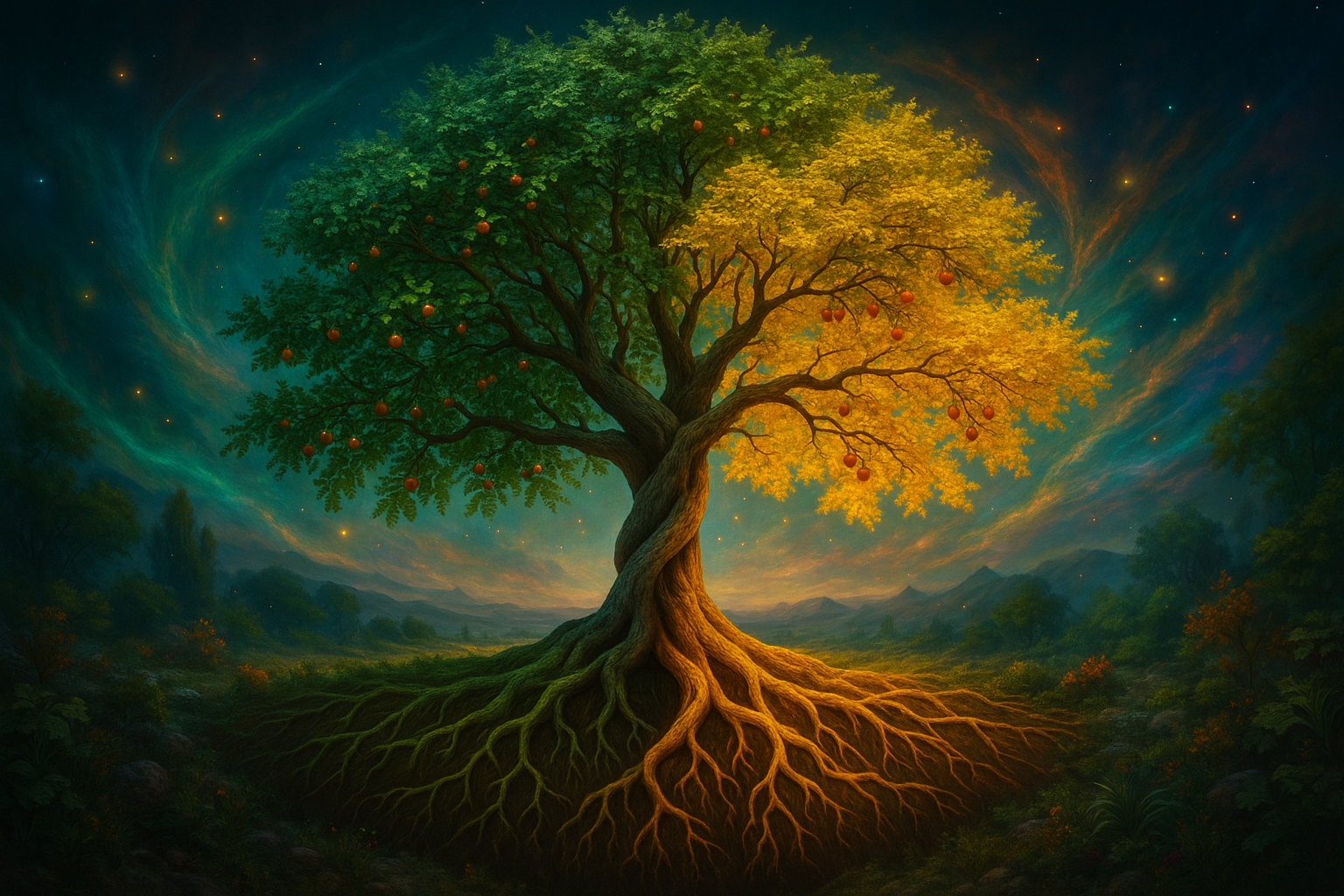
Integration is the long homecoming. It is what happens when we no longer force ourselves to choose between opposites: law or love, structure or freedom, analysis or imagination, God above or God within, masculine or feminine. It is what happens when we discover that truth is not found in halves but in their harmony.
Imagine a community where scripture is studied with rigor, and also sung with joy. Imagine a synagogue, mosque, church, or sangha where children’s questions are honored as much as elders’ wisdom. Imagine a neighborhood where the justice committee and the choir are seen as equally holy. Imagine a family table where every person — young or old, quiet or loud, devout or doubtful — belongs without fear.
Integration is not uniformity. It is more like a symphony, where different instruments keep their unique voices but play in harmony. It is more like an ecosystem, where diversity makes life flourish. It is not compromise. It is maturity. This is when strength becomes gentleness, and gentleness gains strength.
In brain language, it is when the left hemisphere and right hemisphere learn to dance again: clarity serving wisdom, analysis guided by imagination, data held inside story. In spiritual language, it is when transcendence (God beyond us) and immanence (God with us) are held as one mystery. In human language, it is when we finally feel whole.
What Needs to Happen Now
We are already moving. Across the world, people are yearning for reconnection: with one another, with nature, with the past and with neglected parts of themselves. Farmers practicing regenerative agriculture are preaching sermons without words. Poets and musicians are reminding us that beauty heals. Monks and mystics are re-teaching silence. Scientists are mapping the brain and, in their own way, rediscovering what sages said long ago: we need both hemispheres, both halves, to live well.
What needs to happen now is not the invention of something entirely new. It is the remembering of what we already know; that human beings thrive in balance. That faith traditions become strong when they honor their mystics and prophets as well as their priests and scholars. That societies become healthy when law and justice walk hand in hand with song and celebration. That the planet itself will only survive when we treat it not as an object but as kin.
This moment in history feels fragile, but it also feels ripe. The seeds of integration are everywhere. What is required is the courage to nurture them, the humility to admit what has been lost, and the hope to imagine what wholeness might look like for the generations to come.
Conclusion: Toward Wholeness
The Heroine’s Journey ends not in conquest but in reconciliation. Humanity’s story has mirrored this arc: beginning in balance, drifting into imbalance, finding power but losing soul, and now awakening in the desert, longing to come home.
Wholeness does not belong to one religion or culture. It is larger than Judaism, Christianity, Islam, Hinduism, Buddhism, or any single path. It is larger than atheism or humanism. It is the deeper truth that all of us — believers in one God, many gods, or none — share the same earth, breathe the same air, and carry the same longing for meaning.
To move toward wholeness is to learn again to love the parts we once rejected: to honor body as well as spirit, earth as well as heaven, intuition as well as reason, story as well as law. It is to remember that we were never meant to live in halves.
The task is daunting, but it is also holy. Each act of integration, each moment when strength serves love, each time we reconcile with our roots, each community that holds difference without fear, brings us one step closer.
If the Hero’s Journey ends with a treasure carried back to the village, the Heroine’s Journey ends with the village itself made whole. That is the treasure we need now.
And perhaps this is the invitation for our time: not to fight for which path is right, but to walk together into the larger story.
Leave a Reply