
By Brock
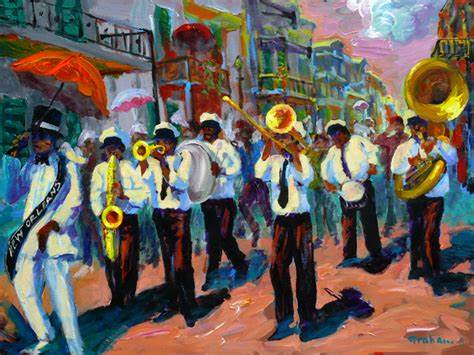
New Orleans pulses with a magic unlike any other city. The air hums with the smoky sweetness of creole cooking, the brassy notes of a second-line parade echoing down the street. The magic, a palpable presence, is found on every corner. Many things are unique to this city, but what truly sets it apart is that the food, the music, the superstitions, and the people.
I feel for those who go to New Orleans and only experience Bourbon Street. It’s quintessential New Orleans, too, but it’s the New Orleans of excess, where gaudy, oversized cocktails are thrust into hands, and the music is drowned in the din, lost beneath the flashing neon. The magic is lost. New Orleans is always better with a touch of restraint.
I prefer the experience of a balcony in the French Quarter near St. Louis Cathedral. A wrought-iron fence draped with vibrant paintings of jazz musicians, the scent of pralines mingling with the damp river air, the second-line parades, and the fortune tellers—there is always something to experience there, balancing on the blade between light and dark. Like watching a fortune teller’s eyes, knowing she saw more than she revealed, a thrilling, almost frightening, glimpse into the unseen. That feeling, that delicate dance between the known and unknown, is also the best way to describe voodoo, a religion as worthy of the city.”
Voodoo, or Vodou, isn’t some spooky sideshow act. It’s a living, breathing religion, born in the heart of the African diaspora. Carried to America in the hearts of the enslaved, ripped from their homelands, their cultures, their very souls. They brought with them the spirits of their ancestors, the wisdom of their elders, the power of their gods. These beliefs were refined in the brutal crucible of the Caribbean, particularly in Haiti. Here they met the Catholicism of the colonizers. And out of that collision, Vodou was forged.
Think of it as a river, flowing with many tributaries. West African spiritual traditions are the main current, but you’ll find Catholic saints, Indigenous Taino spirits, and New Orleans folklore all swirling together. It’s a religion of syncretism, of adaptation, of survival. It’s about honoring the lwa, the spirits, the intermediaries between the human world and the divine. Each lwa has their own personality, their own preferences, their own domain. Some are fierce, some are gentle, some are mischievous. They take the shape of African Gods, Christian saints or local spirits. They’re not just abstract concepts; they’re present, they’re involved, they’re part of the fabric of daily life.
Now, that “balancing on the blade” I mentioned before. That’s key. Voodoo isn’t about black and white, good and evil. It’s about the shades of gray, the delicate dance between light and shadow. It acknowledges the power of both creation and destruction, healing and harm. Just like life itself, it’s complex, it’s nuanced. Its New Orleans.
And yeah, there’s the magic, the rituals, the altars, the offerings. But it’s not about Hollywood theatrics. It’s about connection, about respect, about working with the spirits to navigate the challenges of existence. It’s about finding strength in community, in tradition, in the unseen forces that shape our world.
You see, voodoo, much like New Orleans itself, has been misunderstood, exploited, and sensationalized. People see the surface, the stereotypes, the cheap thrills. But underneath, there’s a depth, a richness, a wisdom that deserves respect. It’s a religion that speaks to the resilience of the human spirit, the enduring power of culture, the undeniable presence of the sacred.
So, when you see those fortune tellers in the French Quarter, those altars tucked away in hidden courtyards, remember that you’re glimpsing a fragment of something much larger, much older, much more profound. It’s a vibrant echo of a world remade, a testament to the enduring magic of New Orleans. And like the best of the city, it carries that hint of danger, that knowledge that the line between the seen and the unseen is always thin, always shifting.
Tarot Readings
Tarot, as we know it, didn’t simply materialize in the French Quarter. Its roots lie in 15th-century Europe (maybe it was Egyptian or Chinese, the stories are as varied as the decks). Initially a card game, but a game with a story. These cards, with their allegorical imagery, began to take on a more esoteric significance, evolving into a tool for divination and contemplation. The journey of the tarot mirrors the journey of many cultural elements of New Orleans: it traveled, it adapted, and it transformed.
When European settlers, particularly the French, arrived in New Orleans, they brought with them their cultural baggage, including games and nascent mystical traditions. The city, a melting pot from its inception, became a fertile ground for these ideas to mingle and mutate.
Here’s where the connection to Christianity becomes crucial. The imagery of the tarot, especially the Major Arcana, resonated with Christian symbolism. The Fool’s journey, a central narrative in tarot, can be seen as an allegory for the human soul’s quest for spiritual enlightenment, a theme deeply rooted in Christian mysticism. This overlap allowed tarot to integrate into the spiritual landscape of New Orleans, a city where Catholicism was a dominant force.
While the core of Voodoo comes from West African traditions, it is a syncretic religion, meaning it readily absorbs elements from other belief systems. As Christianity became intertwined with Voodoo in New Orleans, so too did aspects of Christian mysticism, including tarot.
It’s important to understand that tarot’s integration into New Orleans Voodoo is less about direct influence and more about the city’s unique cultural soup. European mysticism, filtered through Christian lenses, became a part of the spiritual toolkit used by some Voodoo practitioners. It’s a testament to the city’s ability to blend seemingly disparate traditions into something uniquely its own.
Think of it this way: New Orleans is a living archive of cultural exchange. Tarot, like other elements, found its place within this archive, becoming another layer in the city’s complex spiritual history. It tells a story, not just of the “Fool’s” journey, but of the journey of ideas, of how they travel, adapt, and become woven into the fabric of a place.
It was a surprising turn when my doctoral studies into Christian Hermeticism led me to the tarot. Initially, I was wary, it was too woo woo for me. Especially given my upbringing where it was often demonized, lumped with ouija boards and séances. I was particularly struck by the book, Meditations on the Tarot: A Journey into Christian Hermeticism, often attributed to Valentin Tomberg. This massive work, both in size and scope, offered a profound understanding. As it states, “thus the Arcana of the Tarot with which we are occupied constituted a practical school of education for the imagination.” And indeed, it educated.
In my formative years, deeply entrenched in Mormon traditions, I developed a habit of seeking divine guidance through scripture. I’d pose a question, then intuitively open to a random passage in the Book of Mormon, the Doctrine and Covenants, or the Bible, interpreting the text as a direct response. As a youth, it was the Book of Mormon that held the answers. As a missionary, the Doctrine and Covenants, with its detailed laws, rules, and revelations attributed to Joseph Smith and other prophets, became my primary source. Later, in my twenties, the Bible took precedence. This practice, while seemingly arbitrary to some, fostered a deep sense of connection to the sacred texts and my inner voice.
Nearly two decades of rigorous self-examination, deconstruction, and reconstruction of my beliefs followed. This journey led me to question the rigidity of my former faith and to explore a wider spectrum of spiritual and philosophical thought. Yet, amidst this transformation, I recognized a consistent thread: the act of seeking insight through texts. Whether it was the familiar pages of scripture or, now, the symbolic language of the tarot, this practice continued to resonate as a powerful tool for accessing my intuition. I found that the core of the practice was less about the specific text and more about the act of asking a question and then looking for an answer in a text. This led me to explore other religious texts, including the I Ching and Sikh scriptures, each offering unique perspectives and pathways to self-discovery. The tarot, while a relatively new practice for me, is a method I am learning to enjoy and use to listen to my own intuition, providing a visual and intuitive framework for understanding my experiences and navigating life’s complexities.
In New Orleans, I decided to explore this further, bringing a tarot deck to immerse myself in the city’s magical and historical atmosphere. Boosted by my researching into many books ranging from the occult to the Christian I feel like I had a gained an extensive understanding of what each card meant. I offered readings for friends, and even John received a reading from a renowned local tarot reader. What truly astonished me was my own experience. I had a pressing career question, and I performed three separate, detailed 10-card tarot readings. Each reading presented a unique narrative of my past, present, and future, yet all three told the same core story. Furthermore, all three concluded with the same identical card as the projected outcome—a statistical improbability of 1 in 6084. I laughed so hard when the last card was pulled out the third time in a row. It was beyond belief. This experience challenged my skepticism and instilled a sense of wonder in the magic of New Orleans.
The King of New Orleans
New Orleans provided a much-needed revitalization. The spiritual stagnation I’d been experiencing for months was revitalized by an invigorating surge of energy. It was liberating to embrace the music, the uninhibited joy, and the vibrant life that defines this extraordinary place. It was precisely what I needed. I danced with Louis Armstrong as we sang “What a Wonderful World.” I ate divine redfish and creole cooking with Emeril Lagasse. I walked the streets and cast spells with the Voodoo Queen, Marie Laveau. I was New Orleans.
Leave a Reply