
Barcelona is our Secret Reset.
It’s our Jet Lag Playground. When we go to Europe, we try to make it a ritual to stop here—not just to break the journey but to lean into the chaos of it. We don’t fight jet lag. We treat it like an invitation.
We arrive at dawn, the light breaking over the old city in pink and gold. We shuffle through customs, dazed but thrilled, taxi into the heart of Barcelona, check in, and collapse. Sometimes we sleep so long we wake up at ten at night. And that’s fine. That’s Barcelona’s grace: the city doesn’t punish you for being out of step. It’s alive whenever you are. Tapas at midnight. Wine at two. Laughter spilling onto the cobbled streets until sunrise.
It’s our time-bending sanctuary.
This time, at the hotel front desk, we asked for something different.
“Do you know anything unusual? Local? Not the typical tourist stop?”
The host’s eyes lit up. He leaned in, lowered his voice a fraction, and said: “There’s a speakeasy. It’s behind a Pakistani grocery store. You’ll walk right past it if you’re not paying attention.”
We grinned at each other—John and I—already hooked. Olivia would come along for the ride, just for the FOMO.
That night, we set out through the shadowy Gothic Quarter, Olivia in the middle holding both our hands. The narrow streets glistened from a late rain, streetlamps glowing like low-hanging stars.
We walked past the address three times before realizing this was it: a humble little grocery, buzzing with harsh fluorescent light, the smell of spices heavy in the doorway
Inside, refrigerators were filled with rows of identical Pepsi bottles. They could have been sold if needed, but felt more like set dressing than real stock.
We looked at each other, part sheepish, part excited.
I cleared my throat and gave the attendant the word we were told. He nodded and talked to a shopkeeper who picked up a phone and said something inaudible. A moment later, someone appeared to lead us in.
We followed through the narrow passage, and suddenly the world changed.
The speakeasy was underground.
It wasn’t just hidden. It was extraordinary. A vaulted Gothic space transformed by design. Exposed ancient stone. Massive chandeliers dripping with warm light and color. Velvet banquettes. Walls lined with surreal artwork. The menu was a record. Bartenders who moved with theatrical precision, stirring cocktails in cut crystal under pools of candlelight.

It was one of the most extravagant, beautiful bars I have ever seen.
We sipped cocktails, Olivia swirling her soda with her straw, eyes wide at the transformation.
But what truly made the night magic wasn’t even there.
Connected to this place—above the grocery store itself—was a flamenco theatre.
When the staff offered tickets right there, we didn’t hesitate. We bought them on the spot, went out for dinner in the old quarter, our heads buzzing with luck and possibility, and then made our way back through the labyrinthine streets for the show.
Inside, it was intimate but not small. The space felt carved from time. Exposed brick walls, worn wooden floor. Candles in iron sconces. Small round table with dimly lit candles. We were so close you could see the sweat, the expressions, the truth.
We were among the few people there. It felt like an invitation to something holy.
And the show they gave us was unforgettable.
Flamenco isn’t just dance. It’s history set on fire. It’s Romani caravans and Moorish palaces. Jewish laments and Andalusian folk songs. It’s exile and belonging, defiance and surrender.
It started with the guitarist. Every note deliberate, dark and golden, like honey dripped onto hot coals. Then the two singers: one whose voice held soaring, intricate trills that danced with the guitar, another who sang the low, mournful lines with a rawness that carved the room open. They balanced each other perfectly—light and shadow in sound.
Then the dancers.
There was a male dancer, the epitome of flamenco masculinity. Everything about him was controlled violence turned into art. He stamped and spun with impossible precision, daring the floor to defy him. His posture was regal, his gaze sharp enough to cut glass.

There was a younger woman, dressed in a traditional long red dress, castanets clacking at her fingers. She danced with fiery passion, but also a youthful lightness. Every flick of her wrist and turn of her head was fierce, unapologetic, yet undeniably elegant.
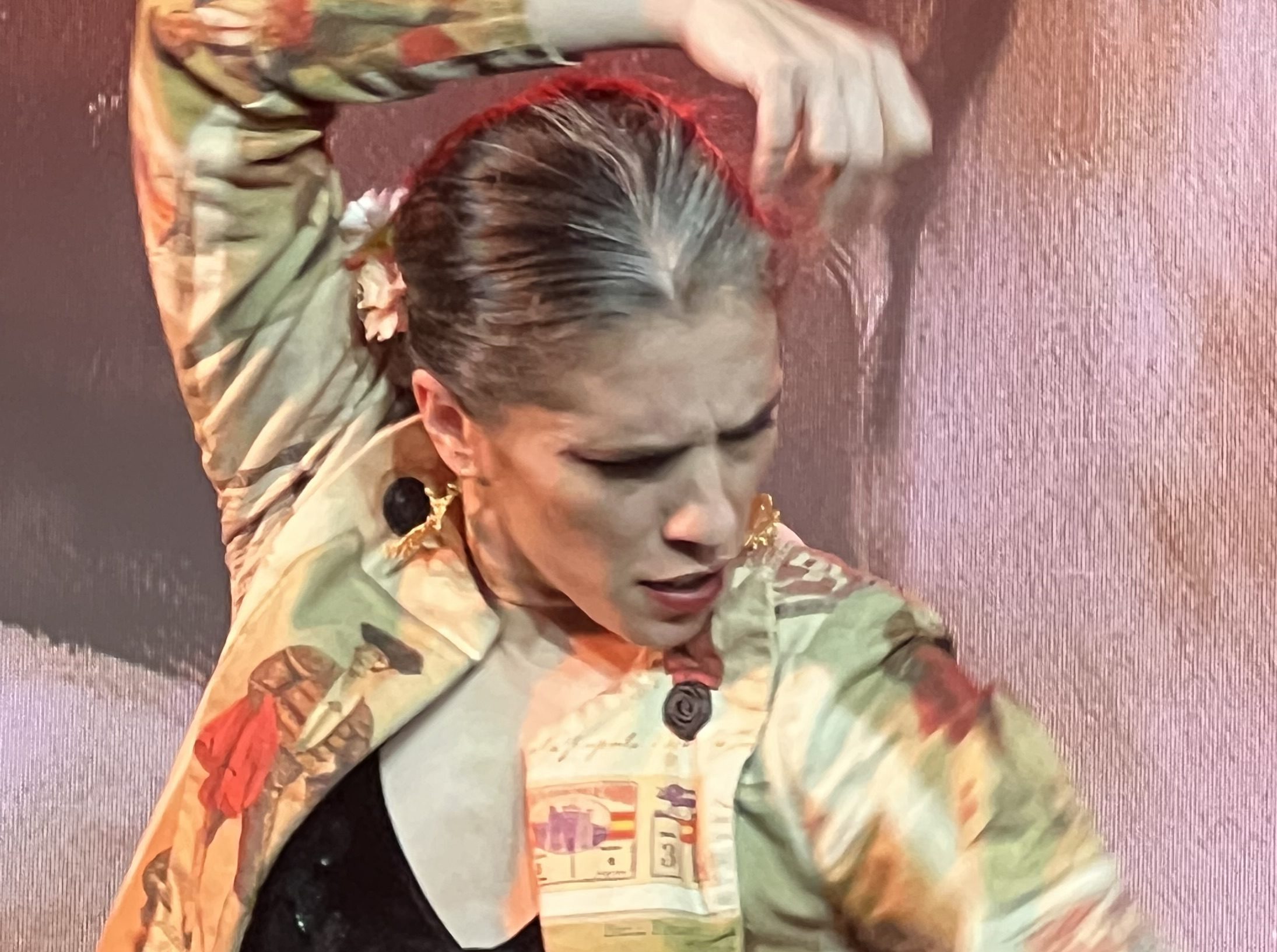
And then there was the older woman.
She was something else entirely.
She didn’t just dance. She embodied flamenco.
Her dark hair was streaked with silver, pulled back so tightly you could see every line carved by time.

She wasn’t just performing. She was channeling something older than language.
Her expressions were intense. Longing. Powerful. Every movement held ferocity and lightness at once. She moved with a quiet command, her footwork an earthquake contained in the space of a heartbeat.
But there was more.
She was agile, graceful—able to spin so tightly she seemed to vanish into movement, only to explode outward with a sudden, precise stamp that rattled the chairs. Her feet moved like they were summoning fire from the wooden floor, pounding out rhythms so complex they felt like incantations.
She didn’t need the usual flamenco trappings to mesmerize us. She wore no grand, flaring dress that rippled when she turned. No castanets to punctuate the air with their click. She relied only on herself—her body as instrument, her face as story.
Her arms were poetry in motion. They coiled and unfurled with a serpentine elegance, slicing the air one moment, softening like water the next. She shaped invisible lines around her, claiming the space as her own.
Her feet were percussion. They were drum and heartbeat, thunder and whisper, leading us somewhere deep and ancient.
And her face—her face held everything. Determination. Defiance. Sorrow. Joy. She didn’t smile to please us. She didn’t soften to make us comfortable. She invited us to see her, unfiltered.
She was flamenco. Every line, every angle, every breath was perfection in what flamenco is meant to be: raw, true, unapologetic expression. She didn’t need adornment. She didn’t need permission.
She was presence itself.
And when she wasn’t dancing, she was watching the others with a focus that was almost feral. Cheering them on. Clapping rhythms to fuel them. Lending them her presence like a gift.
That’s what struck me most about her.
Presence.
Not loud or desperate. But undeniable. She didn’t take the room. She held it. She offered herself to it so completely that we were compelled to pay attention.
She didn’t need anyone’s permission. She didn’t beg for applause or chase the crowd. She stood there in the fullness of who she was and said, Here. This is me. And by doing that, she gave everyone else permission to be real, too.

Afterward, Olivia and I talked about it, both of us struggling to name the magic.
“It’s like,” I said, “you could put a hundred Instagram influencers in that room, all posing, all trying to be seen, and people would still watch her.”
Olivia nodded, understanding exactly what I meant even if neither of us had the perfect words.
It wasn’t because she was the youngest or the prettiest or the flashiest. It was because she was present. Because she didn’t shrink. Because she shared something true.
She was power. But also grace. The kind of grace that doesn’t hoard the spotlight but fuels it for others. She cheered them on. Fed them her fire. Let them be the stars while she made sure they burned bright.
And that—that—is what I want for Olivia.
When I think about Olivia, I often think about how hard it is to be her age right now. How badly she wants to be seen, but also wants to hide. How every mistake feels magnified. How you can try to be real and instantly have people ready to tear you down for it. It’s so easy to get small. To pull back. To protect yourself by showing less.
She’s learning who she is in a world that doesn’t always make space for the messy, the intense, the true. She’s figuring out how to be big without being a target. How to share herself without apology.
I don’t want her to be less intense. I want her to be too much. I don’t want her to hide that ferocity to make other people comfortable.
I want her to know it. To master it. To trust it.
I want her to stand fully in who she is and offer it to the world with that same grace. To share her intensity in a way that doesn’t scorch, but ignites. That doesn’t demand the spotlight for herself, but makes sure there is a spotlight—and that everyone on the stage shines.
Because she has that in her.
She can be the one in the circle whose eyes catch yours and say I see you. The one whose clap sets the rhythm for everyone else. The one whose presence makes others bolder.
She doesn’t have to be the star.
She can be the energy.
She can be the fire that lights them all.
I think I need a little of that myself.
Leave a Reply